


Let’s be honest — if someone said “we’re going to drill sideways underground without digging up the road,” you’d probably raise an eyebrow. And fair enough. But that’s essentially what Horizontal Directional Drilling (HDD) does, and it’s quietly one of the most impressive techniques in modern construction.
Whether you’re managing a civil project along a busy Melbourne arterial road, running utilities beneath a Queensland creek, or trying to get a pipeline under a heritage-listed streetscape in Adelaide without upsetting anyone — HDD is often the smartest tool in the shed.
So, let’s break it down. What exactly is Horizontal Directional Drilling, how does it work, and — more importantly — when do you need it on your site?
What Is Horizontal Directional Drilling (HDD)?
Horizontal Directional Drilling is a trenchless excavation method used to install underground utilities — think pipes, conduits, cables, and more — without the need to dig open trenches along the entire route.
Here’s the basic idea: a guided drill bit enters the ground at a shallow angle at one end of the proposed route, travels horizontally underground (steered precisely with GPS and electronic guidance systems), and exits at the other end. Then, the installed conduit or pipe is pulled back through that same bore path.
The result? A buried utility line running cleanly underground — with minimal disruption to whatever’s on the surface above it.
Think of it like threading a needle, except the needle is a 10-metre drill rig, the thread is a pipeline, and the fabric is 50 metres of compacted soil.
It sounds almost too clever, right? But it works — and it works extremely well.
How Does the HDD Process Work?
A typical HDD project follows three main stages:
- Pilot Bore
A small-diameter drill bit is steered along the planned bore path. An electronic beacon in the drill head transmits its position to a locator on the surface, allowing the operator to steer the drill with precision — even around obstacles.
- Reaming
Once the pilot bore is complete, the hole is gradually enlarged using progressively larger reaming tools. Drilling fluid (typically a bentonite slurry) is continuously pumped through the bore to stabilise the hole and carry cuttings back to the surface.
- Pipe Pullback
The final product pipe or conduit is attached to the reamer and pulled back through the completed bore path. Job done — cleanly, efficiently, and with minimal surface disturbance.
4 Common Reasons You’ll Need HDD on an Australian Construction Site
So when does HDD actually make sense over conventional open-cut trenching? Here are the four most common scenarios you’ll encounter on Australian projects.
- You’re Crossing a Road, Railway, or High-Traffic Area
This one’s a no-brainer. Open-cutting through a major road or rail corridor involves traffic management, lane closures, public safety barriers, council permits, and a whole lot of people very unhappy with you.
HDD eliminates all of that surface disruption entirely. The drill goes under the road — no excavation, no lane closures, no jackhammers at 7am. The surface above stays completely intact.
For Australian projects near state highways, rail networks, or even busy suburban streets, HDD is often the only approved method for crossing. It’s not just the practical choice; it’s frequently the regulatory one.
- You’re Working Near Waterways, Wetlands, or Environmentally Sensitive Areas
Australia’s environmental regulations are no joke — and rightly so. Crossing a creek, river, estuary, or wetland with open-cut trenching can mean disturbing aquatic habitats, increase sediment runoff, and trigger strict environmental impact assessments.
HDD is the go-to solution here. The bore runs under the waterway entirely, meaning the riverbed, banks, and surrounding vegetation are left completely undisturbed. It’s a critical technique for utilities crossing areas protected under state and federal environmental laws.
According Hydrovac Pty Limited, HDD is particularly valuable for utility contractors because it allows them to work in sensitive environments where conventional methods simply aren’t viable — maintaining compliance while still delivering the infrastructure.
- You Need to Install Utilities Beneath Existing Infrastructure
Imagine you’re installing a new gas main beneath an existing water main, a stormwater culvert, and a set of telecommunications conduits — all running across each other underground, in a tight corridor, in the middle of a developed suburb.
That’s a very real scenario on Australian sites. And it’s one where HDD earns its keep.
Because HDD is guided, the drill path can be designed in advance to navigate beneath (or around) existing buried assets with precision. No guessing, no accidental strikes, no emergency callouts at 10pm because someone cut through a high-voltage cable.
Combined with hydrovac excavation for potholing and locating existing services beforehand, HDD is a genuinely powerful approach to complex underground environments.
- The Site Conditions Rule Out Open Trenching
Sometimes the ground itself is the problem.
Rocky terrain, unstable soils, high water tables, coastal sand — these are all conditions that make open-cut trenching slow, expensive, or structurally risky. A trench that keeps collapsing, flooding, or requiring constant shoring support isn’t just a nightmare to work in — it’s a safety liability.
HDD sidesteps all of that. The bore is self-supporting (thanks to the drilling fluid and the liner), and the drill path can be engineered to stay within suitable soil strata. On sites with challenging geology, this can mean the difference between a project that runs on schedule and one that blows out by weeks.
HDD vs. Open-Cut Trenching: A Quick Comparison
| Factor | HDD | Open-Cut Trenching |
| Surface disruption | Minimal | Significant |
| Traffic/road closures | Not required | Often required |
| Environmental impact | Low | Higher |
| Suitable for water crossings | Yes | Rarely |
| Works near existing assets | Yes (guided) | Risk of strikes |
| Project timeline | Faster in complex environments | Slower in restricted areas |
| Cost | Higher upfront | Lower for simple, open sites |
| Best for | Urban, sensitive, and constrained sites | Open rural terrain with no restrictions |
As a general rule: if your site is constrained in any way — by roads, waterways, existing infrastructure, or environmental rules — HDD is likely worth the conversation.
FAQs About Horizontal Directional Drilling
Q: What types of utilities can be installed using HDD? Almost anything that can be pulled through a bore — water mains, gas pipelines, electrical conduits, telecommunications cables, sewer lines, and stormwater infrastructure. If it fits down a bore hole, HDD can install it.
Q: How deep can HDD go? Depth depends on the equipment and soil conditions, but most commercial HDD projects in Australia operate between 3 and 15 metres below ground level. Deeper bores are possible for major crossings like highways or large waterways.
Q: How long does an HDD bore typically take? A standard urban bore of 50–150 metres can often be completed within a day or two. More complex crossings with wider reaming requirements may take longer. Your contractor will provide a project-specific timeline based on the bore design.
Q: Is HDD suitable for rocky ground? Yes, though it requires appropriate drill tooling. Modern HDD rigs are capable of boring through rock, though this does add to project cost and time compared to soft soil conditions.
Q: Do I need council approval for HDD works? Yes, generally. Road reserve access, environmental approvals, and utility crossing permits are still required — HDD doesn’t remove the need for proper approvals. It does, however, significantly reduce the complexity of traffic management and environmental management requirements.
Q: How does HDD complement hydrovac excavation? They’re a natural partnership. Hydrovac excavation is used before and during HDD projects to safely expose and locate existing underground services (potholing), create entry and exit pits, and verify bore exit points — without the risk of damage to existing assets.
Why Australian Construction Sites Are Turning to HDD More Than Ever
The trend is clear. Urban density is increasing. Environmental compliance requirements are tightening. Road networks are busier. And the demand for new utilities — NBN, EV charging infrastructure, gas, water, renewables — isn’t slowing down.
All of those points to more constrained, more complex underground work. And HDD is perfectly positioned to handle it.
It’s not the cheapest option for every job. If you’re running conduit through a flat paddock with no road crossings and no environmental sensitivities, open-cut is probably fine. But the moment your site gets complicated — and most Australian civil sites are complicated — HDD starts to pay for itself pretty quickly in avoided delays, reduced approvals burden, and plain old site practicality.
Final Thoughts
Horizontal Directional Drilling isn’t some flashy new technology. It’s been around for decades. But the way it’s being applied on modern Australian construction sites — in combination with hydrovac methods, GPS-guided steering systems, and tighter environmental controls — makes it one of the most relevant and in-demand techniques in the industry right now.
If you’re planning a project and you’re not sure whether HDD is the right approach, the best starting point is a site-specific assessment. Not every bore is the same, and the variables — soil type, depth, crossing length, existing assets, environmental zone — all matter.
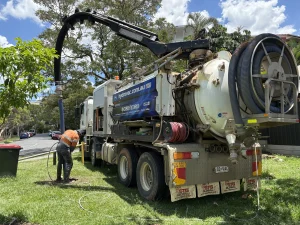
At Hydrovac Pty Limited, we work alongside civil contractors, project managers, and asset owners across Australia to help figure out exactly that. Whether it’s advising on bore feasibility, carrying out pre-HDD potholing with our hydrovac units, or supporting active HDD projects on the ground — we understand what’s involved, and we know how to get the right outcome for your site.
Have a project in the pipeline? Get in touch with Hydrovac Pty Limited today and let’s talk through your options.